


Tradable securities

¿How colombian law defines securities?
A security, as defined by Article 2 Law 964 of 2005, shall mean any negotiable instrument that forms part of an issuance, where the purpose or effect of such issuance is to raise funds from the public, including the following:
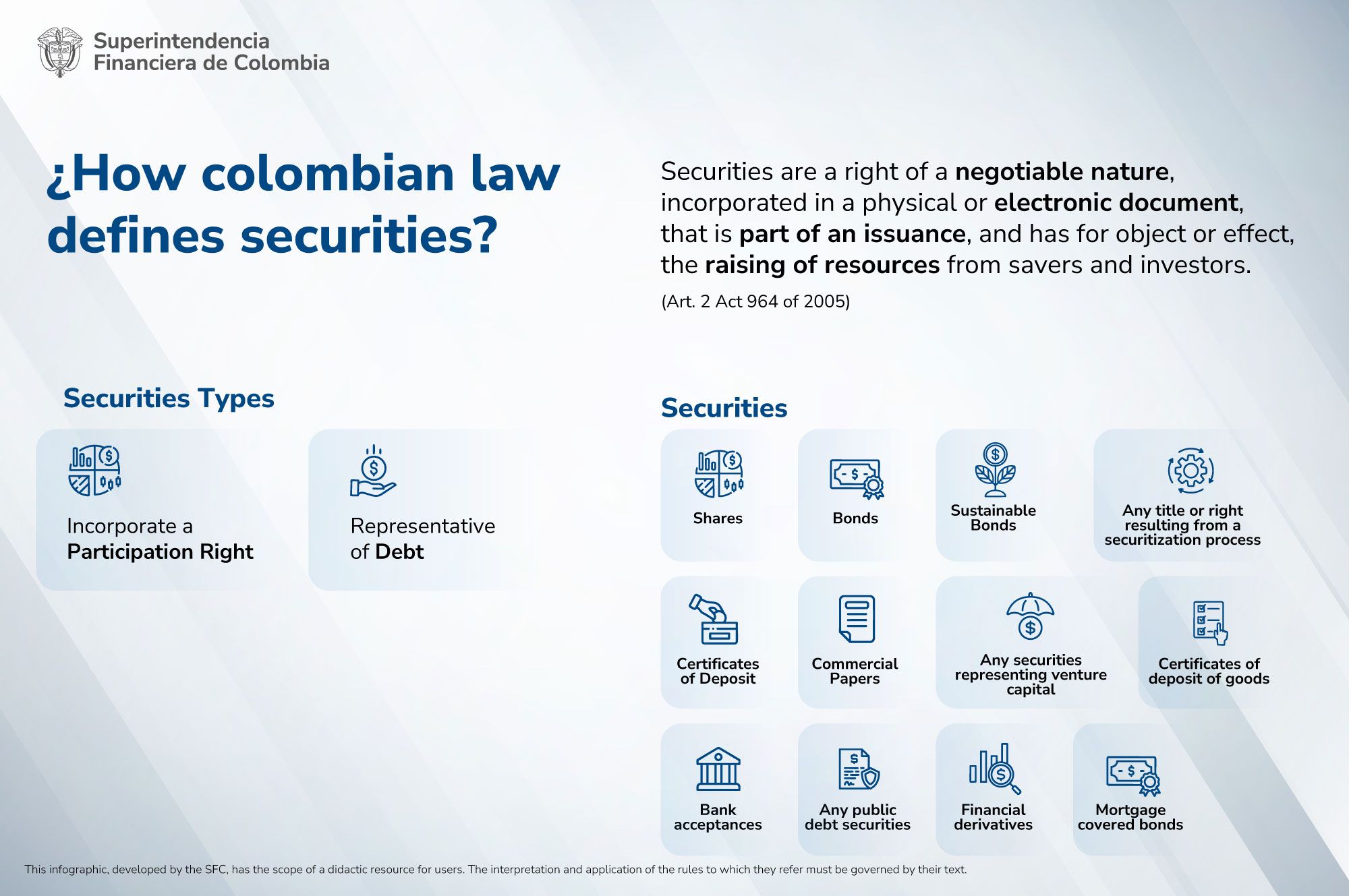
1. Ordinary shares
Ordinary shares grant their owners the rights to:
- Participate in the general meeting and vote in the company's decisions submitted for its consideration.
- Receive a portion of the company's profits, depending on how many shares you own.
- Sell or transfer your shares freely, unless the company or other shareholders have a preferential right to buy them first.
- Review the company's books and documents before meetings to stay informed.
- Receive a share of the company's assets if the company closes, after all debts are paid.
2. Preferred shares
Preferred shares offer their owners certain benefits in addition to those of common shares:
- They receive their money first if the company goes out of business, up to the value they paid for the shares.
- They have priority to receive a fixed portion of the company's profits, ahead of owners of common stock.
- They may have other additional economic benefits, depending on what has been agreed in the terms of the shares.
3. Preferred dividend shares with no voting rights
These shares may not represent more than 50% of the total capital of the company. Some benefits for the owners of these shares are:
- They first receive a minimum dividend (a portion of the profits), which is established in the rules when the shares are purchased.
- Share in the additional profits along with the owners of the common shares, after receiving their minimum dividend.
- Receive an extra dividend if earnings permit, equal to the minimum dividend and to that given to owners of common stock.
- To accumulate dividends if in any year they are not distributed in order to receive them in the following years, according to what has been established in the subscription rules.
- Voting rights, except in the case of decisions that impact the preferences that these shares grant, their owners do NOT have the right to vote in the decisions of the meeting. It is important to note that in S.A.S. (Simplified Joint Stock Companies) different types of shares can be created such as those that pay a fixed annual dividend or that allow employees to be shareholders, making the company more accessible to them.
4. Debt representative instruments
Commercial Papers: They are promissory notes publicly offered in the stock market, issued massively or serially. The term of the commercial papers must be greater than fifteen (15) days and less than one (1) year, counted from the date of issue.
Private debt bonds: These bonds are issued by private companies in which the National Government has no participation. They allow private companies to borrow money at favorable interest rates and customized terms to finance their projects or expansions. There are several types, for example, those that repay the money through partial payments or amortizations during the term of the bond, or those that repay the principal plus interest in a single payment when the bond matures.
Public debt bonds: These bonds can only be issued by public entities as a way to finance themselves. When they are designed to be traded, placed and fulfilled simultaneously in multiple international markets they are known as Global Bonds.
Thematic bonds: These are earmarked bonds whose objective is related to generating a positive environmental, social, governance or economic development impact. There are several types of thematic bonds: Green, Social, Sustainable, Linked to sustainable and development goals.
5. Any title or right resulting from a securitization process
Securitization is a process that converts illiquid assets or assets that generate cash flows in the future into securities, so that investors can trade them in the public securities market.
Characteristics:
- It transforms low liquidity assets (that cannot be easily sold) into assets that can be sold quickly.
- Allows to anticipate the money that these assets will generate in the future.
- The risk of non-payment of the debt is transferred to the investor who buys the securities.
- The term of these securities is generally at least 1 year.
Benefits: Originators (those who own the assets) can raise money without going into debt or committing their equity directly. They can do this through companies with an exclusive corporate purpose (securitization companies) and also trust companies.